TRADING AROUND EARNINGS.
A stop protects you while the market is open. It does nothing while it's closed.
And the biggest overnight moves a stock makes all year usually come on the morning after its earnings report. If the stock opens 20% below your stop, your stop fills 20% below where you planned, and the loss you sized as 1R becomes 3R, 5R or worse.
This isn't rare. In our measurements, with a stop half an ADR below the close before the report, 32% of momentum-stock reports opened below the stop, and the average fill was a loss of about 3R.
That risk is much bigger in the fast-moving stocks swing traders actually trade, where a 10% or 20% gap on a report is nothing unusual. Holding through earnings is a coin flip with very fat tails.
Why earnings break the usual rules
Every rule in a swing trading plan assumes the price moves continuously. You buy at one level, you set a stop at another, and if the stock falls you're taken out near the stop. Position size is calculated on that assumption: shares = dollar risk ÷ (entry − stop).
An earnings report breaks that assumption once a quarter. The company publishes its results before the open or after the close, when you can't trade at normal liquidity, and the next session opens wherever the new information puts it.
Nothing trades in between. A stop-loss order becomes a market order at the open, and it fills at the open, however far below the stop that is.
The tighter your stop, the worse this gets. Halving the stop doubles your share count for the same planned risk, so it also doubles the damage from a gap. As the tight-stop post puts it, a tighter stop doesn't remove risk, it converts stop risk into gap risk. That's an acceptable trade on a quiet stock with no catalyst ahead, and a bad one through a report.
What the sources do
The traders this blog draws on mostly agree: don't let a report catch you with a full position and no cushion.
- Qullamaggie doesn't hold through earnings or FDA decisions without a big profit cushion, and in community notes of his streams he says not to buy within three days of a report. He handles overnight risk in general through position size and by checking catalyst dates, and he holds many positions partly because he has seen stocks gap 50% overnight.
- A five-day cutoff for new positions is a common, more cautious version.
- A stricter version drops a name from the watchlist when its report is within about a week, exits ahead of earnings unless the trade is already 2R or more in profit, and wants a cushion of about 3 ADRs (average daily ranges) to hold overnight or into a report.
- Pradeep Bonde notes that biotech gap risk is large in both directions, so size has to stay small.
The other side of the same coin is opportunity. The morning after a report is when episodic pivots happen: a stock gapping up 10% or more on huge volume after a genuine surprise, which Qullamaggie trades every earnings season.
Some traders treat earnings season as a filter in its own right. Stocks crushed on their reports come off the list for a few seasons, and a good report with no price reaction goes on a delayed-reaction watch. The common thread is to let the report happen first and trade the reaction, rather than bet on the outcome.
How a gap turns 1R into 5R
The arithmetic is short. If you set your stop a distance d below the price and the stock gaps down by g, then once g is bigger than d:
A 5% stop and a 15% gap is a 3R loss. A 2.5% stop and the same gap is 6R.
Because traders size every position to the same R, a gap through the tightest stop in the portfolio does the most damage. A single bad gap can undo a month of careful small losses.
Measuring the gap in ADRs makes it comparable across stocks. A 15% gap is a catastrophe for a stock that moves 2% a day, and an ordinary bad morning for one that moves 10%. If your stop sits one ADR below the price going into the report, the loss in R is simply the gap measured in ADRs.
Three choices before a report
1. Sell before the report
This is the cleanest choice, and the default for any position without a profit cushion. You give up the chance of a gap up, and you lose nothing you didn't plan to lose. If the setup is still good after the report, you can buy it again, often at a better level and with the uncertainty gone.
2. Hold a reduced core with a cushion
If the trade is well in profit, a gap down may only take back part of the gain. A sensible starting point is at least 2R in profit, or about 3 ADRs of cushion above your stop. Sell part of the position before the report (a third to a half is common), and keep the rest with the stop at break-even or better.
The cushion is what makes this a calculated risk rather than a bet. The gap has to be larger than the cushion before the trade turns into a loss.
3. Size for the gap, not the stop
If you want to hold a position into a report, or open one just before it, size it as if the stop weren't there. Pick a gap you think is plausible for the stock, and size so that a gap of that size costs no more than your normal risk:
For fast-moving momentum stocks, 20% is a reasonable assumption, because gaps that big do happen on reports.
On a $100,000 account risking 0.5% ($500), a $100 stock with a 20% assumed gap allows 25 shares, a $2,500 position. That's usually far smaller than the stop-based size, which is the point.
What not to do: open a new full-size position, sized off a tight stop, in the days before a report. That combines the largest share count with the largest gap risk.
A real gap: DDOG in August 2026
Datadog (DDOG) shows how quickly this happens. It was a momentum leader going into its second-quarter report, and a breakout bought two sessions before the report, with a tight stop at the day's low, would have looked like a textbook trade.

The results came out before the open, and the stock opened nearly 20% lower, almost four ADRs, far below that stop. The breakout wasn't a bad setup. A breakout two days before a report is really two trades at once: the breakout, which your stop manages, and the report, which it doesn't. That's exactly what the three-day rule and a five-day cutoff are there to prevent.
A rule set
- Know every date. Every week, check the next report date for every open position and every name on your focus list. Note whether it falls before the open or after the close, because that decides your last chance to act.
- No new full-size positions inside the window. Use three trading days (Qullamaggie), or five if you want more caution. If a setup triggers inside the window, pass, or take it sized for the gap.
- No cushion, no hold. A position that isn't at least 2R in profit, or about 3 ADRs above its stop, gets sold before the report.
- With a cushion, hold a reduced core. Sell a third to a half, keep the stop at break-even or better on the rest and accept that now and then a report will still take the cushion back.
- Size for the gap when you hold. Make the worst plausible gap, not the stop, cost no more than your normal risk. For momentum names, 20% is a sensible assumption.
- Trade the reaction, not the outcome. After the report, look for the gap-ups worth buying as episodic pivots, and rebuy the leaders whose setups survived.
- Review what earnings did to you. Tag every trade held through a report and compare its results with the rest. If your largest losses cluster on report days, the rule set isn't being followed.
See every report date before it sees you
The rule set starts with knowing the dates and the cushion on every position. TradePiko puts both in front of you:
- Earnings dates in Live Positions. Every open position shows its next report date, marked before the open (BMO), after the close (AMC) or TBD when the company hasn't confirmed the timing.
- ADR Multiple and Worst Case. Live Positions shows how many ADRs each position has moved since your entry, which is your cushion, and your P&L if the selected stop were hit right now. Remember that a gap can fill well beyond it.
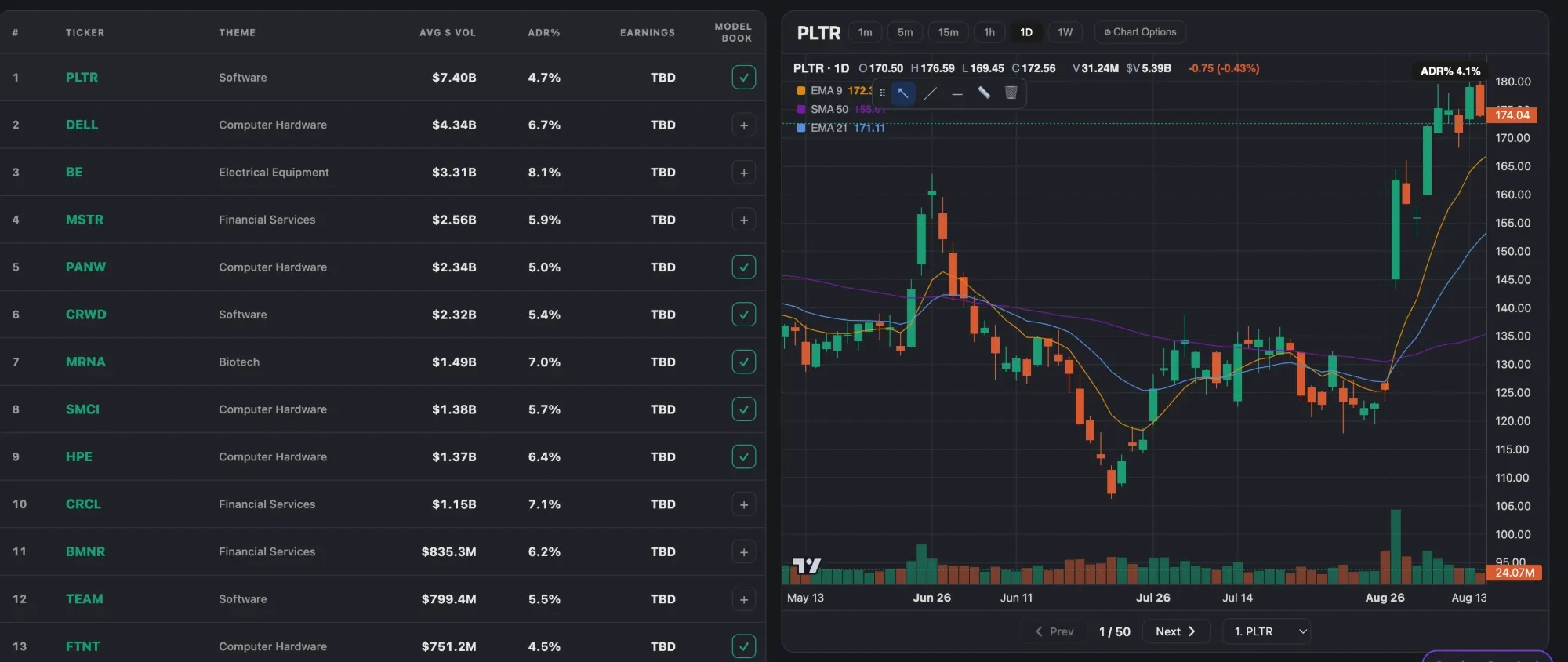
- Earnings dates on the PIKO 50. The nightly list of the top 50 momentum leaders shows each name's next report date next to its ADR% and dollar volume. On the October 23, 2026 list, 32 of the 50 names had a report due within three weeks.
- Tags and Trade Simulation. Tag the trades you held through earnings, then use the By Tag preset to see your results with and without them, compared against what you actually did.
Sources and credits. Some ideas are adapted from public trader interviews and notes. Not holding through earnings without a big profit cushion, managing overnight risk through position size and catalyst dates, and seeing stocks gap 50% are Kristjan Kullamägi's (Qullamaggie), from his Chat With Traders interview; the three-day rule is from fan-compiled notes of his streams. The biotech caution is Pradeep Bonde's (Stockbee). The DDOG breakout entry is hypothetical, built on real prices. Educational content only.