WHY THE BEST SWING TRADERS WIN ONLY 25–35%.
Momentum swing traders who cut losses fast and let winners run lose on most of their trades.
That's not a flaw in the method. It's simply how the method works.
Qullamaggie says he's profitable at a 25–30% win rate. Marios Stamatoudis builds his whole approach around the same trade-off: a low win rate paired with large, lopsided winners, which he argues holds up better when market conditions change than a system that depends on being right.
The low hit rate is the price you pay for a tight stop. Ordinary noise will hit it, but each loss is small, and each real winner is worth many times the risk. So a 30% win rate works as long as the average winner is several times the average loser.
Put round numbers on it. Win 30 trades in 100 at an average of +4R, lose the other 70 at −1R, and you're up 50R. That's +0.5R per trade, from a strategy that's wrong seven times out of ten.
What it costs you is comfort. You'll sit through long losing streaks, and you'll spend most of your time below your last equity high.
What the pros actually report
The traders most associated with modern momentum swing trading are open about how often they're wrong. Here are a few figures, all as reported by the traders themselves in interviews and results:
- Kristjan Kullamägi (Qullamaggie) describes his approach as profitable at a 25–30% win rate, built on small losses and big winners. In his Chat With Traders interview he put his win rate at about 25% in 2019 and 35% in 2020, and said most of his money comes from 10–20% of his trades.
- Marios Stamatoudis treats the win rate as the part of a system the market controls, and reward-to-risk as the part you control. In his framework, small fixed risk plus a few outsized winners is the sturdier design, and at a 20% win rate a run of eleven or more losses inside 50 trades is close to certain.
- Pradeep Bonde (Stockbee) shows the other end of the range. His episodic pivots win about 70% of the time in good markets, because they ride news-driven moves rather than tight breakouts. For the breakout style, a useful rule of thumb is that if your win rate is under 40%, controlling losses is the main job.
None of them are trying to be right more often. They're trying to keep their losses small and their winners large, and the win rate is just a side effect.
Why tight stops and big winners mean a low win rate
Two choices push the win rate down, and both are deliberate.
A tight stop gets hit more often. A stop at the low of the entry day, or half the average daily range, sits inside the normal wiggle of a volatile stock. So plenty of trades that would have worked with a wider stop get shaken out first.
That costs you win rate. What it buys you is R, because halving the stop doubles the R-multiple of every winner. A 25% gain, for example, is 8.3R on a 3% stop and 16.7R on a 1.5% stop. (See why a tighter stop can mean far more upside.)
Letting winners run turns small wins into scratches. A trade that's up 2R and then falls back to a break-even stop isn't a win anymore. A trader who banked every 2R pop would have a much better win rate, but they'd also cap every winner at 2R, and the whole style depends on the few trades that go to 10R or more. The maths of that trade-off is in why a 40% win rate can beat 70%, so we won't repeat it here.
Both choices only pay off if the losses really do stay small. A stop that slips, or one you hesitate over, turns a 1R loss into 2R or 3R, and at a 30% win rate there's very little room for that. That's why Qullamaggie's rule is simply to sell when the stop is hit.
What a low win rate asks of you
The arithmetic is the easy part. The hard part is living inside it.
Losing streaks are certain, so they're not a warning sign. At a 30% win rate, long runs of losers are a mathematical certainty over any meaningful sample. Over 100 trades at a 30% win rate, a run of ten losses in a row is more likely than not. The answer is to cut your size through the streak and restart small, not to change a strategy that's doing exactly what it should.
You'll spend most of your time below your high. Qullamaggie makes the point that you spend most of your time in drawdown, even in a great year. If you measure each day against your best day, a low-win-rate style is going to feel like failure most of the time.
You can't skip the boring trades. The few winners that pay for everything aren't predictable in advance. Skipping setups after a losing run is the most common way to miss them, which is why sizing down works better than stopping. The flip side is that trading less only pauses a drawdown. It doesn't fix one.
What the big winners look like
The pay-off for all of that is a handful of very large trades.
Qullamaggie says most of his money comes from 10–20% of his trades. In round numbers, that means one 20R winner can pay for twenty full losses, and two or three of them can carry a whole year of small stop-outs.
Tight stops are what turn ordinary moves into numbers like that. Here are two breakouts where a move most people would call "good, not great" turned into a trade worth well over ten losses. (The entry and exits follow the plan from how to trade breakouts: a third sold at the close of day 3, the rest trailed on the 21-day EMA.)
A sub-1% stop on a quiet base: LRCX in September 2025
Lam Research (LRCX) spent about six weeks going sideways after a strong run, in a base roughly 14% deep. It was a calm stock, with an average daily range under 3%, so a stop a third of a range away was very close.

It opened just above the base and never looked back, and the stop sat less than 1% under the entry. A third came off at the close of day 3, already worth more than twelve times the risk, and the rest rode the 21-day EMA for a month. The position gained about 18%, which is a nice trade, but measured against that tiny stop it was +19.6R.
A three-day burst from a deep base: AMD in September 2026
AMD had built a base about 20% deep over seven weeks, after a run of nearly 60% from its spring low. When it broke out, it opened above the base and the stop went just over 1% below the entry.

The stock ran hard for three sessions, and the third sold at that close made more than fourteen times its risk. The rest gave back a chunk of the gain before closing below the 21-day EMA in October, but it still finished well in profit. The whole position made about 13%, and it came to +11.2R, enough to pay for eleven full losses.
How to find your own win rate and R profile
None of the numbers above are yours. To judge your own trading, you need the same few figures from your own history:
- Record the initial risk on every trade. That's entry price minus initial stop, times shares. Without it you can't express results in R, and you can't compare a 3% stop trade with an 8% one.
- Convert every result to R. Divide the profit or loss by the initial risk. A full stop is about −1R, and a trade that made three times what you risked is +3R.
- Work out four numbers per setup: win rate, average win in R, average loss in R, and expectancy. Use at least 30 trades of one setup, in one kind of market.
- Look at the shape, not just the average. Group your trades into buckets (full stop, small loss, scratch, 0.5–2R, 2–5R, 5–10R, 10R+). Then check what share of your total R came from your best 10% of trades, and what your longest losing streak was.
- Compare it with what the shape needs. A 30% win rate is fine if your average loss stays near −1R and your winners average 4R or more. It's a problem if your average loss is −1.5R because stops slip, or your winners average 1.5R because you sell too early.
The most common finding is that the win rate is fine and the averages aren't. Either losses run past the stop, or winners get cut at the first sign of a pullback. Your MFE and MAE will show you which one: MFE and MAE explained.
See your real win rate and R profile
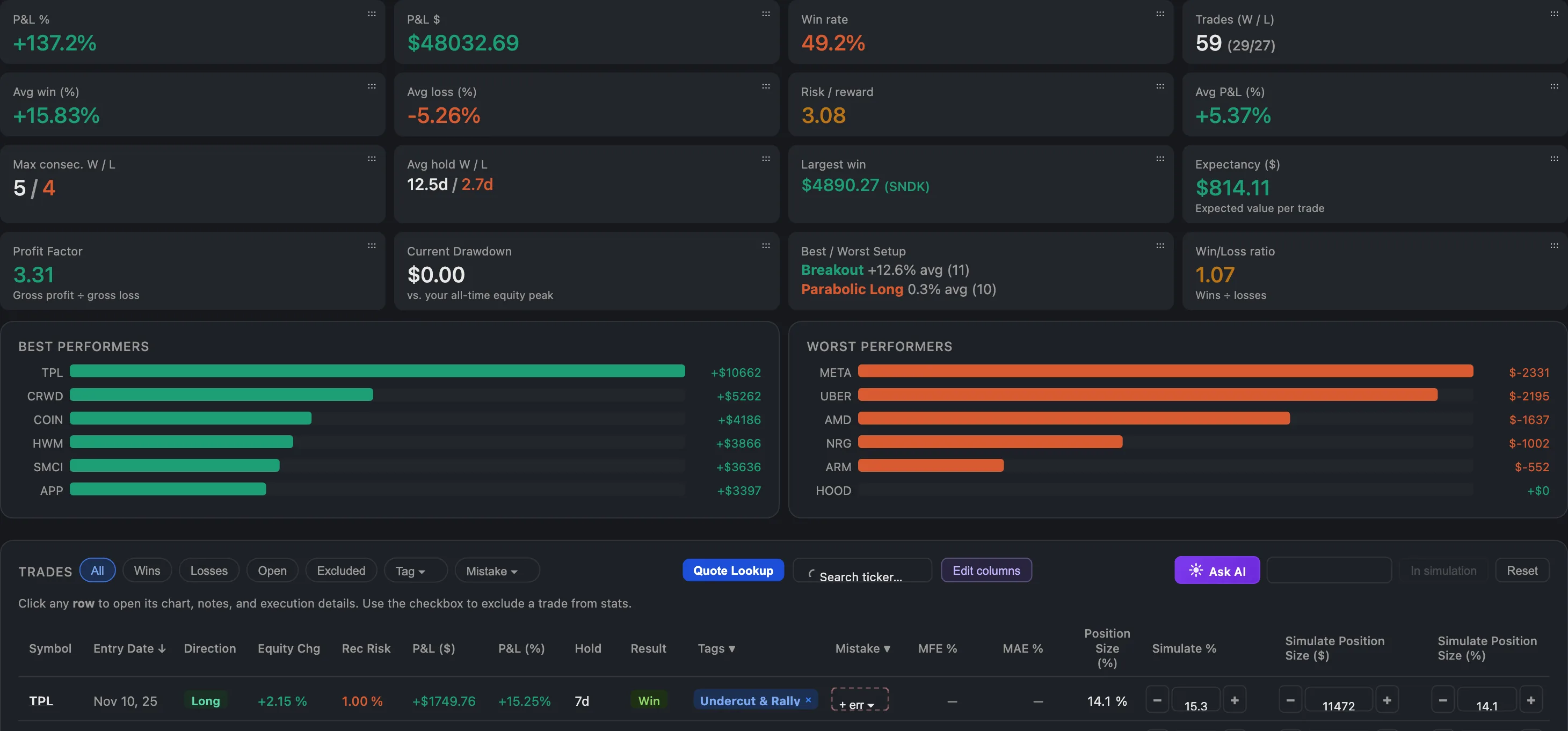
You don't need to build any of this in a spreadsheet. TradePiko works it out from your broker history:
- Win rate, average win and loss, expectancy and profit factor for your whole history, plus your longest runs of consecutive wins and losses and a best-and-worst breakdown by setup tag.
- MFE and MAE on every trade. See whether a low win rate comes from tight stops doing their job, or from stops being moved and winners being sold too early.
- Trade Simulation. Change the exit on any past trade, split it into a partial and a runner, or change its size, and TradePiko recalculates total P&L, win rate and expectancy against what you actually did, with both equity curves on one chart.
- AI Trade Coach. Ask questions of your own history, like "what share of my profit came from my best ten trades?"
Sources and credits. Win-rate and R-multiple figures for Kristjan Kullamägi (Qullamaggie) are as reported by him, including in his Chat With Traders interview. Selling the moment the stop is hit is Qullamaggie's rule. Marios Stamatoudis's views on win rate, asymmetry and losing streaks are from his Momentum Trading Bootcamp; Pradeep Bonde's episodic-pivot win rate is as he reports it. Some ideas are adapted from public trader interviews and notes. Qullamaggie's 25–30% figure is from his post My 3 timeless setups that have made me tens of millions. The LRCX and AMD examples are replayed by TradePiko from daily and hourly bars. They are past examples picked because they worked, and are illustrative, not a guarantee of future results. Educational content only.