THE COMPLETE SWING TRADING GUIDE.
Swing trading means buying a stock and holding it for a few days to a few weeks to catch one leg of a bigger move, and then getting out. You're not investing for years, and you're not trading every tick of the session either.
Most of the work happens outside market hours. You scan and plan after the close or at the weekend, and your orders, alerts and stops sit with the broker. That's why it suits people with a job.
It's simple to describe and slow to learn. The momentum swing traders this blog draws on win only about 25–35% of their trades. Qullamaggie's win rate was about 25% in 2019 and 35% in 2020, and Marios Stamatoudis designs his system for a low win rate on purpose.
They make money because their losses are small and fixed, and a few winners run to many times the risk. So most of the job is protecting your account while you wait for those few.
Expect it to take years, not weeks. Qullamaggie blew up several small accounts from 2011 and had his first profitable year in 2013, and he reckons any single setup takes two to three years to master. Other full-time traders describe close to ten years, most of them part-time, before they could trade for a living.
The good news is that the order you learn things in matters a lot, and you can learn most of it from your own trades.
What experienced traders tell beginners
The traders this blog studies disagree on plenty, but their advice to beginners overlaps. Here it is in our own words:
- Learn one setup first. Qullamaggie tells beginners to start with plain breakouts and leave shorts and parabolic trades alone. The point is to know enough about one thing, not everything about all of them.
- Copy, then adapt. Take a setup that already works for someone, trade it as written until you understand why it works, and only then change it. Pradeep Bonde (Stockbee) says about 80% of the new traders he talks to have no setup at all.
- Study the big winners. Qullamaggie built his edge by going through the monthly charts of thousands of US stocks, about 30 seconds each, pulling out every huge mover and studying what came before it. Bonde suggests looking at 5,000 to 10,000 past breakouts before risking money. A more focused version narrows this to one question, such as liquid stocks that rose 50% in a short span, and covers at least five years of data.
- Start small, and start before you feel ready. More trades means faster feedback, as long as each one is small enough not to matter. Check every claim on your own data.
- Look for a reason first, then the pattern. A hot sector, fast growth or a fresh catalyst gives a stock a reason to move. Skip stocks under $1. Qullamaggie notes that stocks under about $2 are often near bankruptcy.
- Protect the downside, no exceptions. Accept losses, never widen a stop, and don't chase a setup you missed. Chasing out of fear of missing out is what drains accounts.
Stage 1: Foundations
Start with what the style is, and whether it fits your life.
Swing trading goes after a multi-week move several times bigger than a single day's range, and it accepts overnight gaps as the price of that. It needs an hour or so of preparation rather than six hours at the screen. It also comes with a payoff shape that feels wrong at first, because you'll lose more often than you win.
- Swing trading vs day trading: the holding period, time, costs, overnight risk and the US pattern day trader rule change, with a real breakout traded both ways.
- Why the best swing traders win only 25–35% of the time: why tight stops produce low win rates, and what 50 trades at a 30% win rate feel like.
How much money do you need to start? No rule sets a minimum for swing trading. In the US, the old $25,000 pattern day trader minimum ended on June 4, 2026, when FINRA's amendments to Rule 4210 replaced it with an intraday margin standard (brokers can phase the change in until October 20, 2027, so check yours), and it never applied to positions held overnight anyway. What matters more than the starting balance is risking a small, fixed percentage on each trade, so start with money you can afford to lose while you learn.
Stage 2: Risk first
Learn risk before you learn a single setup, because it's the only part you fully control.
Fix the amount you're prepared to lose on each trade as a small percentage of the account (Qullamaggie usually risks 0.25–1%). Put the stop at a level the chart gives you, and let the distance to that stop decide the share count.
A cautious ladder starts a new account at just 0.12% risk per trade, and only steps up after winners. A 50% drawdown needs a 100% gain to recover, so your first goal is never to dig that hole.
- Position sizing for swing trading: the formula, how to choose a risk percentage from your own losing streaks, and gap risk.
- Stop loss placement and position size: why halving the stop doubles your size for the same dollar risk, and what that costs.
- The half-ADR stop: how to set a stop half an ADR below your entry, and when it beats the low of day.
- Drawdowns and losing streaks: losing-streak odds at 30–50% win rates and simulated drawdowns at 0.25–1% risk.
- Progressive exposure: risk little until your trades work, then size up step by step, with a 0.12%-to-1% ladder, or keep risk fixed and hold more positions in good conditions and fewer in bad.
Stage 3: Finding stocks
Most of the edge in momentum swing trading comes from trading the right stocks at the right time. Qullamaggie's scan ranks the top 1–2% of stocks by performance over one, three and six months, and then he checks the charts by eye.
Volatility matters too. The average daily range (ADR) tells you how much room a stock has to move, and how wide a sensible stop is.
And the market sets the odds for everything. Per community notes of his streams, he treats the indexes' 10-day average above the 20-day, with both rising, as the green light for breakouts, and a 10 below the 20 as the red one.
- Relative strength: the RS line against SPY, new RS highs before price, and scanning for the top 1–2%.
- ADR%: the one volatility number every swing trader needs, and how to use it for filters, stop caps and sizing.
- Why market environment matters more than your setup: how to classify the environment, find which of your setups needs which one, and use the 10/20-day moving average traffic light on QQQ as a market filter, tested on 544 breakouts, plus what happens when you sell faster in a weak market.
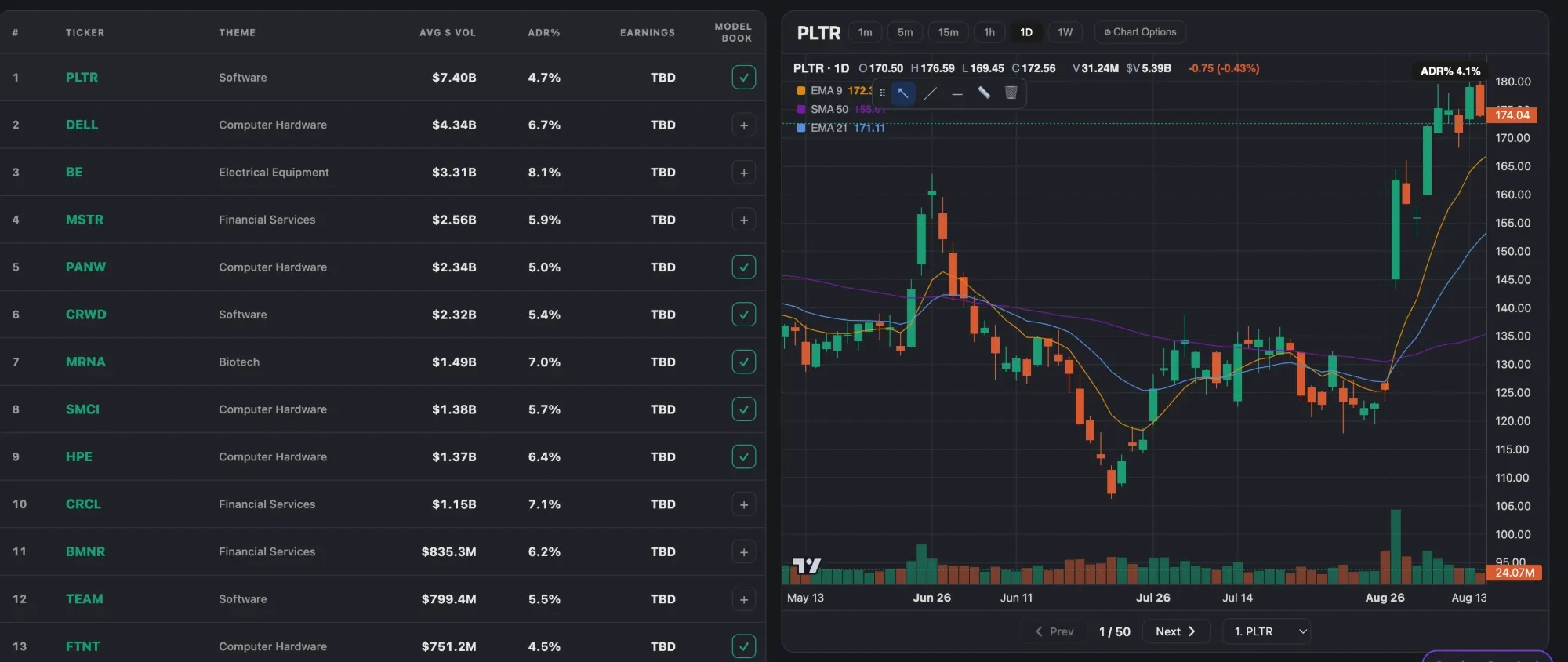
While you learn to build your own shortlist, a ready-made one helps. TradePiko's PIKO 50 is a nightly list of 50 momentum leaders. It's screened for the top 5% of stocks by relative strength, with ADR above 4%, at least $30M a day traded and price above the 65-day average, then ranked by dollar volume, and each name shows its ADR%, average dollar volume and next earnings date.
Stage 4: Setups
A setup is a repeatable chart pattern with defined rules for entry, stop and exit.
Learn the breakout first: a big prior move, an orderly pullback or tight base riding the rising 10- and 20-day averages, and then a range expansion out of it. Pullbacks and the VCP are close relatives that use the same ingredients.
Episodic pivots, parabolic trades and shorts come later. Qullamaggie puts the learning curve for episodic pivots at four to eight earnings seasons. And per community notes of his streams, he tells beginners not to short at all until they're well established.

- How to trade breakouts: the three-step setup, entry, low-of-day stop, a partial after a few days and a moving-average trail, tested on 544 breakouts taken the way one active trader would take them.
- Pullback entries: buying the rising 10- and 20-day moving average, healthy versus failing pullbacks, and five real pullback trades walked through.
- VCP: the volatility contraction pattern: shrinking pullbacks and drying volume, a definition you can scan for, and six real bases, including one that failed.
- Episodic pivots: the 10%+ gap on huge volume after a real surprise, with a checklist and 243 tested gaps.
- The parabolic short: the criteria, opening-range-low and VWAP entries, a high-of-day stop and 10/20-day targets.
- Parabolic long setup: buying a crashed stock as it turns, with five real trades and why the bounces that worked came in broad market washouts.
- How to short stocks: the bounce-into-falling-EMA setup, hourly triggers, stops, sizing, covering, and the risks particular to shorts.
Stage 5: Entries and exits
A setup tells you which stock. The entry and exit rules decide how much of its move you keep.
Qullamaggie buys the break of the opening-range high rather than anticipating it, with the stop at the low of the day. His exit template makes a good default: sell a third to a half after three to five days, move the stop to breakeven, and trail the rest.
For beginners he suggests the 10-day average, selling on the first close below it. Whatever you pick, write the exit down before you enter.
- Swing trading entry techniques: ten entries defined precisely enough to test, from the opening range breakout to the undercut and rally.
- Opening range high entries: 1-, 5-, 30- or 60-minute, tested on 225 breakout days.
- Swing trading selling techniques: six ways to exit a winner and what each one costs you.
- 10-day or 20-day?: choosing a trailing moving average, and close-only versus intraday exits.
Stage 6: Measuring yourself
Once you have trades, judge them with numbers rather than feelings.
Win rate on its own tells you almost nothing. The break-even win rate is 1 ÷ (1 + R), so if your average win is three times your average loss, you only need to be right 25% of the time.
Expectancy (the average result per trade) is the number that matters, and it needs at least 20–30 trades before its sign means much.
Expect most of your profit to come from a handful of trades. In our 544-trade breakout test, the best 10 trades made more than the whole profit, and the other 534 trades together lost money.
- Expectancy in trading: the formula, a worked example, and why win rate alone misleads.
- Win rate vs risk/reward: why a 40% win rate can beat 70%, and what it means for how you exit.
- What is a good profit factor?: gross profit over gross loss, with benchmarks and the small-sample trap.
- MFE and MAE explained: how far each trade ran for you and against you, and what that says about your stops and exits.
- Outlier trades: why ten trades make your year, and what profit targets do to them.
Stage 7: Reviewing and improving
The journal is where a beginner turns into a trader. A regular review process is non-negotiable, and a good study starts from the list of every ticker you've traded.
Once a month, compare your own trades with the best setups the market offered, then annotate the ones you missed. And the most useful backtest you can run is on trades you already took: change one rule and see what it would have done.
- Swing trading journal template: the fields that change behaviour, the ones to leave out, and the review cadence.
- How to review your trades: weekly and monthly checklists, worked through on a sample quarter of 89 trades.
- How to backtest an exit rule on trades you already took: the method, and the traps.
- How to export trade history from your broker: where Schwab, Fidelity, IBKR, Webull and Robinhood hide the export, and what the columns mean.
Stage 8: Choosing a journal
A spreadsheet works for your first trades, but it gets slow as the log grows.
For swing trading, the features that matter are automatic import from your broker, each trade drawn on its daily chart, excursion data (MFE and MAE) and reports by setup tag. The comparison pages set out what each tool does well, with prices as of November 2026.
- The best swing trading journals: the six questions that separate them, seven journals side by side, current pricing and a feature table.
- TradeZella vs Tradervue: prices, free plans, replay, AI, broker sync and reports compared.
- TraderSync vs TradeZella: prices, trials, replay, backtesting, AI and markets compared.
- TradeZella alternatives for swing traders: three alternatives, what each does better and what you give up.
A realistic first 90 days
Ninety days won't make you consistently profitable, and nobody serious claims it will. But it's long enough to build the habits every later stage depends on. Here's a sensible plan:
- Weeks 1–2: set up, don't trade. Read stages 1 to 3. Pick one setup, the breakout, and write its checklist, entry, stop and exit on one page. Build a scan for the strongest stocks, and go through past examples of your setup until you can spot one quickly.
- Weeks 3–4: trade tiny. Take only trades that match the checklist, at a risk small enough that a loss means nothing to you. Risking 0.12% of the account per trade is a good model. Place the stop as soon as you're filled, and never move it further away.
- Weeks 5–12: log and review. Record every trade with its setup tag, plus a mistake tag when you broke a rule. Review weekly: did you follow the plan, and what did each mistake cost in R? Step risk up only after a run of winners, and back down after losers.
- Day 90: a checkpoint, not a verdict. Expectancy on 20 or 30 trades tells you its sign at best, and that's the minimum before you judge a setup. A swing trader can need several months or more to reach 50 trades. Judge yourself on rule-following first, because the profit question needs a bigger sample.
Expect losing streaks along the way. At a 30% win rate, a run of at least five losers somewhere in 100 trades is close to certain (99.9%), and the average longest streak is about 11.
That's normal. It isn't a sign the method is broken, and the drawdowns post gives the full odds.
A journal that teaches you from your own trades
Every stage after the first three depends on a clean record of what you actually did. TradePiko builds it from your broker history:
- Broker auto-sync. Trades import from 40 brokerages, and every one is drawn on its daily chart with the entry and exit plotted.
- Setup and mistake tags. Group your results by setup and see what each broken rule cost you. The Daily Report Card grades how you managed each day, not what you made.
- Position Sizing Advisor. Work out the share count from your account risk and your stop before you place the order.
- The PIKO 50. A nightly list of 50 momentum leaders with ADR%, average dollar volume and earnings dates, a shortlist while you learn to scan.
- AI Trade Coach. Ask questions of your own trade history, such as which setup or day of the week is costing you money.
Sources and credits. Beginner advice (start with plain breakouts, two to three years per setup, no shorting early, never widen a stop, don't chase, find a reason to move before the pattern, avoid stocks under about $2), the index 10/20-day rule and the 10-day trail for beginners are from community notes of Kristjan Kullamägi's (Qullamaggie's) streams; his top 1–2% scan, risk per trade, opening-range-high entry, low-of-day stop, day 3–5 partial and the four-to-eight-earnings-season estimate for episodic pivots are from his own "3 timeless setups" article. His win rates, the copy-then-adapt lesson, his early blown accounts and first profitable year, and the monthly-chart history study are from summaries of his Chat With Traders interview and stream notes. Pradeep Bonde's (Stockbee) setup and study figures are from his public posts and interviews. Some ideas are adapted from public trader interviews and notes. Pattern day trader change: FINRA Regulatory Notice 26-10. The 544-trade breakout test is TradePiko's own and is illustrative, not a guarantee of future results; its universe is built from today's stocks, which flatters the results. Marios Stamatoudis's low-win-rate design is from his Momentum Trading Bootcamp. Educational content only.